YouTube vs. Micro-Sync: The Global Rollout of AI “Copyright Swap”
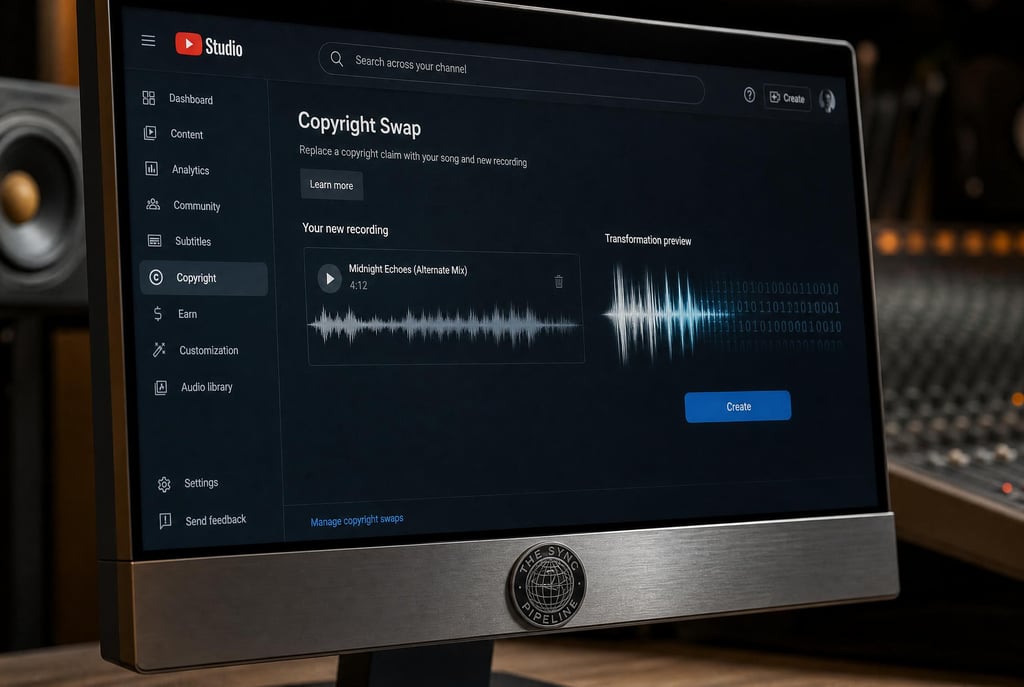
On May 29, 2026, YouTube took a decisive step in automated rights management with the global rollout of its “Create” button within the Replace Song tool. This feature allows creators to instantly resolve a Content ID dispute by replacing a flagged track with an AI-generated, royalty-free instrumental composition. For production music publishers and micro-sync players, this innovation represents a direct threat to traditional licensing volumes in favor of a closed, algorithmic ecosystem.
Klem Loden
6/1/20262 min read
Automating Dispute Resolution
The tool, officially presented by Rene Ritchie (YouTube), radically transforms the copyright claim resolution workflow. Previously, a creator whose video was demonetized by Content ID had to either mute the audio, purchase a replacement license, or accept revenue sharing. Now, YouTube automatically generates four royalty-free instrumental options to substitute the infringing audio with a single click. This mechanism eliminates administrative and financial friction but systematically evicts human rights holders from the revenue pipeline in favor of integrated synthetic solutions.
A Direct Threat to the Production Music Sector
As highlighted by Music Business Worldwide’s analysis, this deployment directly impacts companies like Epidemic Sound or Artlist. These platforms built their business models on providing solutions for copyright “headaches” on YouTube. By integrating its own generative AI (based on Google DeepMind’s Lyria models) directly into the claims dashboard, YouTube is short-circuiting the micro-sync market. Creators no longer need to look for an external alternative: the distribution infrastructure itself becomes the replacement content provider.
Training Data Opacity and the “Walled Garden”
The major B2B stake lies in the provenance of the datasets used to train these models. While YouTube positions itself as an industry ally, the details regarding the training sets for this specific tool remain opaque. For The Sync Pipeline, this confirms the emergence of a “Walled Garden” model: YouTube secures its ecosystem by replacing potentially litigious external assets with fully controlled internal ones. This strategy reduces the platform's dependence on third-party catalogs and redefines the value of background music as a simple, interchangeable technical utility.
“Sync Literacy” vs. the Algorithm
The rollout of “Copyright Swap” proves that in the field of micro-sync, convenience now trumps artistic signature. For publishers, survival no longer depends on the presence of their tracks in the YouTube library, but on their ability to offer value-add that AI cannot yet replicate: a strong brand identity and superior legal security. In 2026, YouTube is no longer just a broadcaster; it is a customs officer offering its own goods to replace those it has seized.