
Operational Sync Literacy (OSL)
The OSL Architecture
A Global Navigation Infrastructure for the Synchronization Industry
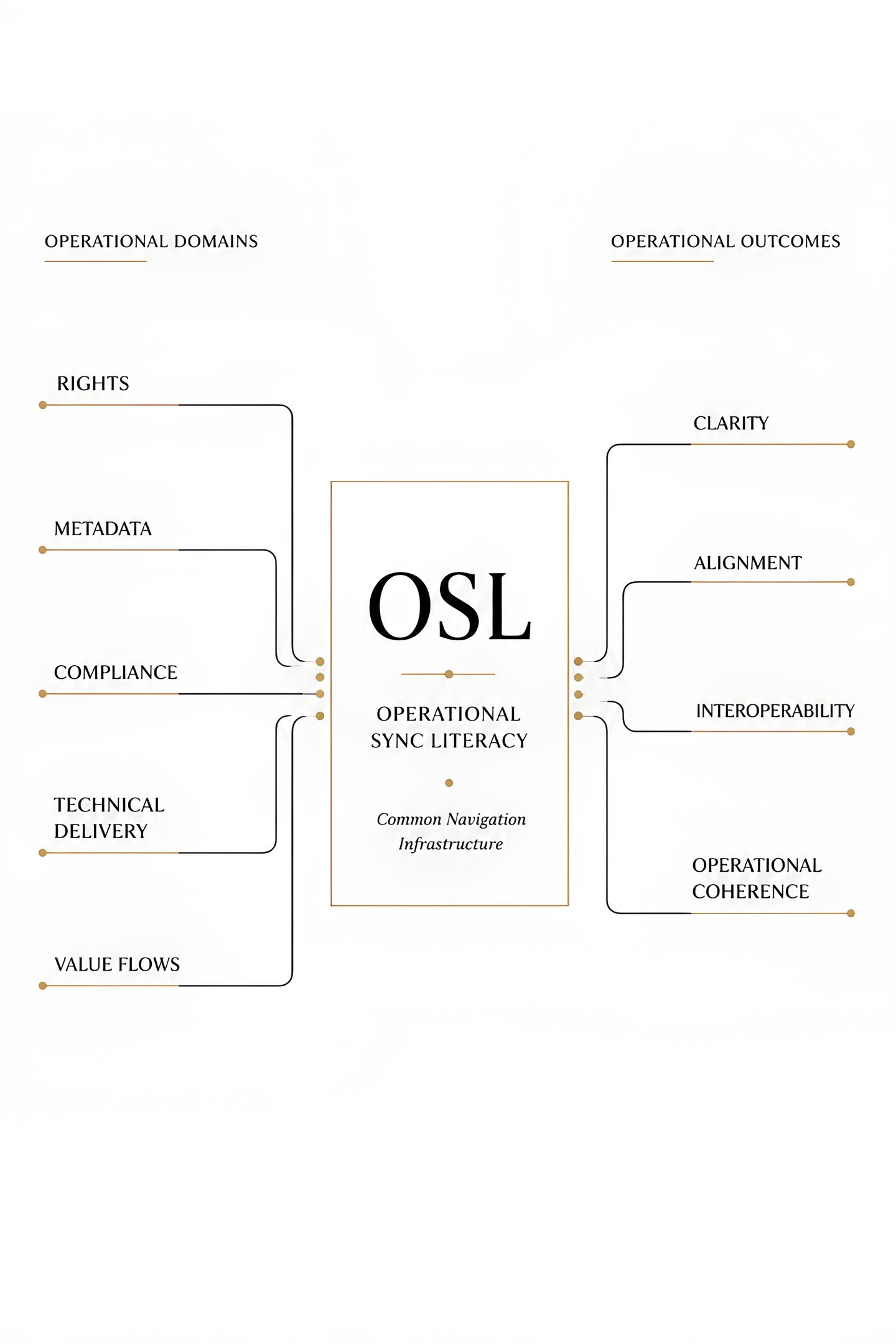
Operational Sync Literacy (OSL) is a global navigation infrastructure built to establish a common technical language across the music and audiovisual industries, particularly where synchronization requires different professions to understand the same operation from rather different sides of it.
As the ecosystem has grown more complex, rights, metadata, compliance, technical delivery and value flows have become parts of the same journey without necessarily travelling through the same hands, departments or systems. Workflows remain fragmented, documentation can describe similar operations differently and standards may arrive at one end of the chain carrying an interpretation rather different from the one they were given at the other, leaving professionals to navigate an industry whose pieces work together while not always speaking quite the same language.
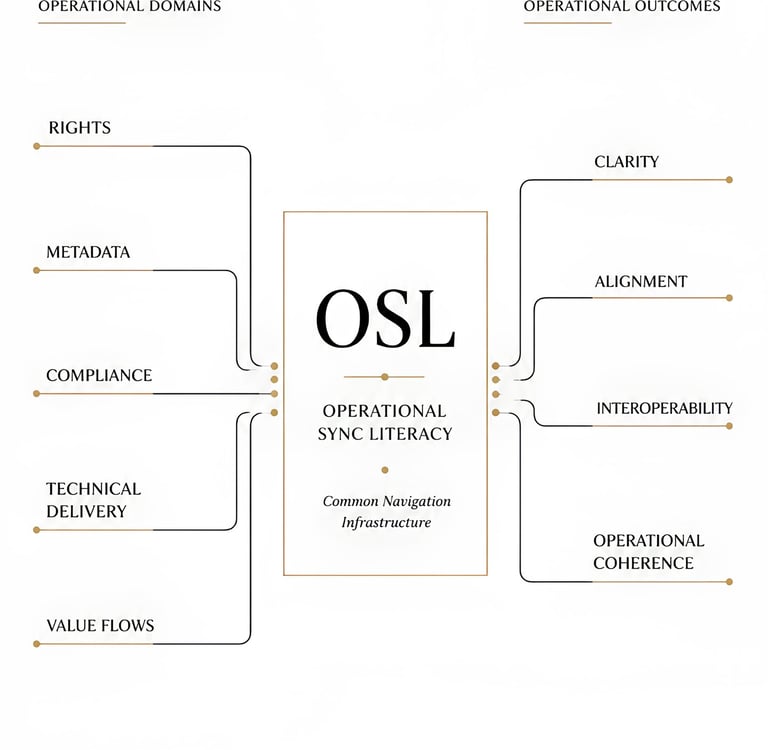
OSL provides the structural frame through which those pieces can be read in relation to one another, creating a shared point of navigation across the synchronization ecosystem so that greater clarity, alignment, interoperability and operational coherence can emerge without pretending that the professions, workflows or systems themselves have somehow become one.
Why OSL Exists
The synchronization industry depends upon a long chain of creative, technical and business stakeholders whose work may begin in very different places before eventually having to meet around the same piece of music. Yet growing interdependence has not necessarily brought the machinery surrounding those professions closer together, and workflows can remain fragmented while documentation changes from one environment to another and operational standards acquire different interpretations as they move between departments. The pieces belong to the same ecosystem, certainly, but the spaces left between them continue to create friction throughout it.
Operational Sync Literacy (OSL) was created inside precisely that space, establishing a common technical language through which professionals can navigate an ecosystem whose complexity increasingly comes from the relationships between its different functions. OSL does not replace the workflows already carrying the work forward, but provides a common navigation infrastructure through which creative, technical and business functions can better locate themselves in relation to one another, allowing greater clarity, alignment, interoperability and operational coherence to emerge across the synchronization ecosystem.
The Sync Pipeline: The Industrial Intelligence Layer
OSL connects five Operational Domains that follow a synchronization asset through the different conditions governing how it is understood, prepared, deployed and ultimately carried through professional environments. Each domain looks at another part of that journey, while their value as a framework lies in seeing what happens where those parts begin to meet.
Rights
The ownership structures, licensing relationships and chain-of-title considerations that determine what can be authorized, by whom and under which conditions.
Metadata
The information that allows an asset to be identified, understood, managed and carried reliably through professional systems.
Compliance
The legal, contractual and procedural requirements an asset must satisfy as it moves towards professional deployment.
Technical Delivery
The specifications and production requirements that allow an approved asset to travel from creative intention into reliable implementation.
Value Flows
The mechanisms through which an asset creates and retains operational and economic value, as well as the points along its journey where that value can begin to erode or become lost.
Clarity | Alignment | Interoperability | Operational Coherence
What OSL Provides
Common Technical Language
A shared vocabulary through which creative, technical, legal and business functions can understand the same operation without allowing its meaning to shift as it travels from one professional environment into another.
NAVIGATION INFRASTRUCTURE
A structural framework through which Rights, Metadata, Compliance, Technical Delivery and Value Flows can be read as parts of the same operational landscape, revealing where their paths cross and how movement in one domain may alter what becomes possible in another.
Industrial Intelligence
A research-driven analytical layer that looks beyond individual developments to examine the market movements, technological shifts and recurring operational patterns gradually taking shape across the synchronization economy.
Educational Architecture
A scalable knowledge structure through which the same technical foundations can travel into academic programs, professional training and institutional applications without losing the common language from which they began.
Academic and Institutional Applications
Beyond its industrial function, OSL was also conceived as an architecture capable of travelling into education, carrying the same technical language and navigation principles into academic programs and professional training without changing what professionals will later encounter once they enter the industry.
The objective is to give synchronization the structure of a professional discipline, with shared terminology, operational literacy and common points of navigation allowing its different functions to be understood in relation to one another. OSL is therefore positioned for future institutional deployment and academic integration across professional music business and audiovisual education environments, where that common language can begin to exist before professionals have to find one another inside the working ecosystem.
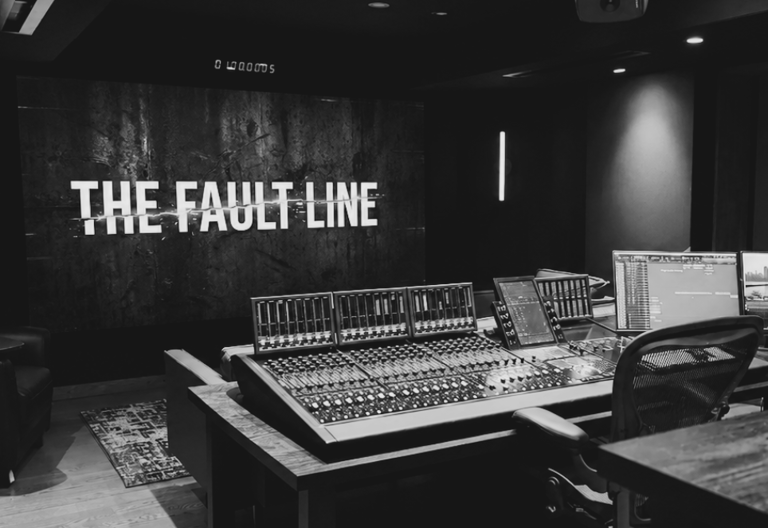
Prototype testing through THE FAULT LINE
THE FAULT LINE, an original sci-fi thriller series created and written by Klem Loden, serves as the current prototype for the OSL Technical Addendum.
In addition to serving as Creator and Screenwriter, Loden is attached to the project as Executive Producer, providing continuity between the project’s creative architecture and the preventive engineering methodology developed for its production.
The project is currently under industry review, including script consideration by Zero Gravity Management, as it progresses toward the production validation required to enter its proposed post-production beta-testing phase.
If advanced to production, the project will provide a real-world environment for evaluating whether preventive engineering documentation can be successfully integrated into professional audiovisual production workflows.
Operational Sync Literacy (OSL)
OSL Technical Addendum
A specialized preventive engineering module for Sound Design and audio post-production.
Within the broader OSL framework, the Technical Addendum carries relevant operational principles into the production environment, translating them into practical specifications for Sound Design and audio post-production. The engineering question consequently enters the process before there is a problem waiting at the other end, allowing selected technical requirements to be considered upstream, while production is still taking shape, rather than discovered later as something post-production must repair.
Specialized Application: OSL Technical Addendum
The Sync Pipeline serves as the Industrial Intelligence Layer of OSL, watching the synchronization economy from the place where individual developments begin to reveal something larger about the machinery beneath them.
Rather than stopping at the event itself, The Sync Pipeline follows what moves behind it, through infrastructure, Value Flows and the decision-making mechanisms shaping the global synchronization economy. Market developments, technological shifts, rights infrastructure and operational friction consequently become points from which recurring structural patterns can be observed, allowing findings gathered across that continuous analysis to travel back into the ongoing development of the OSL framework.