
Warner vs. Crumbl: The $24M Settlement Closure Redefines “Social Sync”
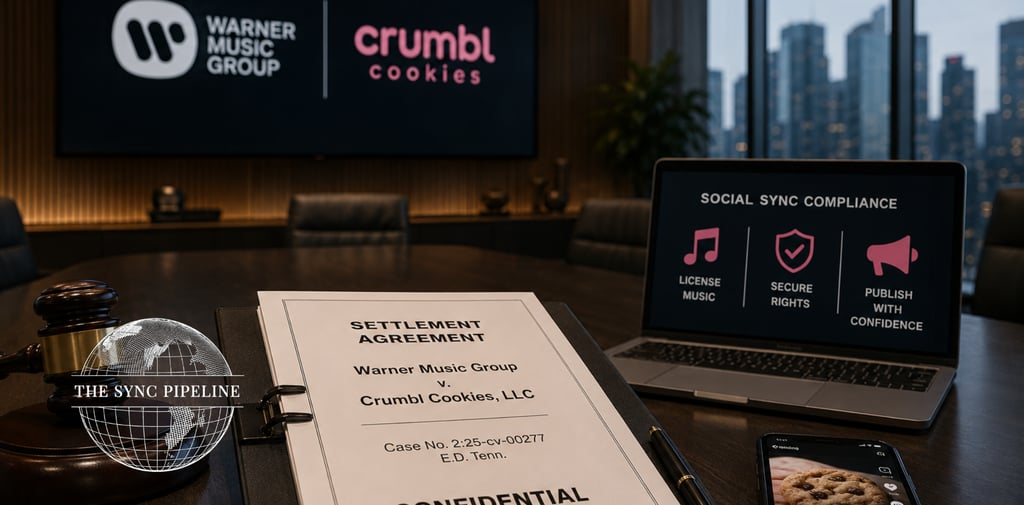
June 19, 2026, marked the critical reporting deadline for one of the most closely watched disputes in the music industry: the Warner Music Group (WMG) vs. Crumbl Cookies case. With the finalization of this settlement, the U.S. court system has officially closed the file on the unauthorized use of 159 tracks across TikTok and Instagram. For the B2B market, this outcome is more than a confidential transaction; it signals the definitive end of brands using “trending audios” for free and establishes a new compliance standard for the digital advertising pipeline.
Klem Loden
6/26/20262 min read
The Finalization of an Industrial Standoff
Initiated in April 2025, the conflict between WMG and the bakery chain Crumbl officially concluded in June 2026. Following the announcement of a settlement in principle in May, the parties adhered to the June 15 judicial deadline to seal the financial and operational terms of the agreement. Although the final amount remains confidential, the shadow of the $23.85 million in statutory damages initially sought was enough to turn this case into a severe warning for marketing departments. The final notification to the court, enacted before the June 19 cutoff, confirms that a “fait accompli” strategy on social media is now a major financial liability.
The Illusion of “Trending Audio” in B2B Environments
The Crumbl case exposed a critical literacy gap among advertisers. The defense often relied on the availability of tracks within the built-in libraries of platforms like TikTok. However, the settlement validates WMG’s position: these licenses are strictly limited to personal use. As soon as a brand utilizes a hit by Lizzo or Dua Lipa to drive sales, it exits the platform’s personal-use framework and enters the Commercial Sync regime. This case demonstrates that structural alignment of rights must precede publication: in 2026, the lack of technical friction during an upload in no way guarantees the legal safety of the asset.
Automated Monitoring: The End of Impunity
At The Sync Pipeline, we analyze this settlement as a victory for surveillance infrastructure. WMG’s ability to identify and document 159 infringements with such surgical precision was made possible by the mass deployment of spectral detection tools. Major labels are no longer waiting for music supervisors to place their tracks; they are using technology to transform social media infringements into structured profit centers via settlements. Brand imprudence has become a predictable revenue stream for publishers, effectively creating a “Reactive Sync” market where forced regularization replaces prior negotiation.
Compliance as the New Standard
The resolution of the Warner/Crumbl litigation imposes a new reality: Social Sync is now a market segment in its own right. Brands must integrate music licensing management into their production chains with the same rigor as media buying. In 2026, the security of a company’s communication pipeline depends on its ability to prove that every second of music used is administratively unassailable. The end of the Crumbl era marks the beginning of total rights-holder sovereignty over digital promotional flows, where legal clarity is the only shield against multi-million dollar sanctions.