
Operational Sync Literacy currently operates as the structural framework supporting The Sync Pipeline and its broader industrial intelligence activities.
Within this infrastructure, the OSL Technical Addendum serves as a specialized preventive engineering module dedicated to Sound Design.
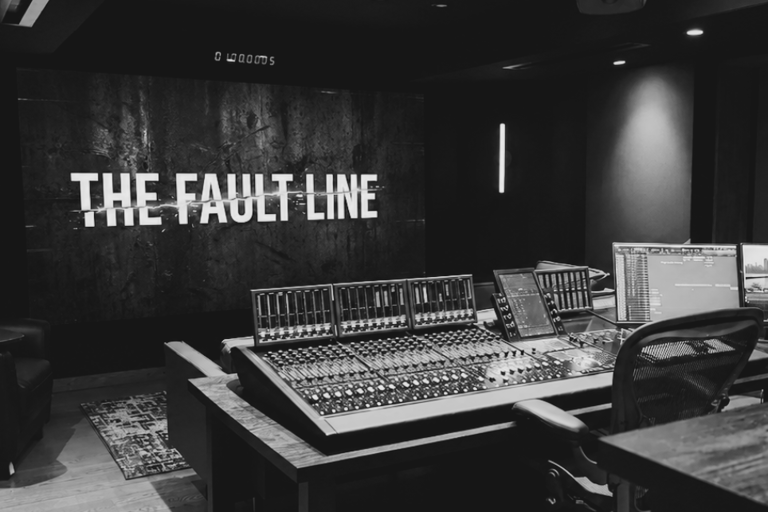
The Addendum is currently being evaluated through THE FAULT LINE, a WGA-registered science-fiction thriller series prototype developed as a practical proof-of-concept and industrial testing laboratory for preventive engineering workflows in audiovisual production.
This prototype evaluates whether engineering specifications introduced at the screenplay stage can reduce post-production friction, improve technical consistency and increase workflow efficiency across audio post-production, sound design and re-recording mixing.
This research initiative represents a specialized application of the OSL framework rather than the framework itself.
Operational Sync Literacy (OSL)
Documented Industry Challenges
A Global Navigation Infrastructure for the Synchronization Industry
Operational Sync Literacy (OSL) is a global navigation infrastructure designed to establish a common technical language between the music and audiovisual industries.
As synchronization becomes increasingly complex, professionals must navigate an ecosystem involving rights management, licensing, metadata, post-production, compliance requirements, platform ecosystems and global delivery standards. Despite this growing complexity, many operational processes continue to rely on fragmented workflows and disconnected standards.
OSL was developed to provide a shared structural framework capable of improving clarity, alignment and interoperability across the synchronization ecosystem.
Why OSL Was Developed
The synchronization industry has evolved significantly over the past two decades. However, many of the operational systems supporting it have not evolved at the same pace.
As a result, professionals increasingly face technical friction generated by inconsistent terminology, non-standardized data, licensing inefficiencies and communication gaps between creative, technical, legal and commercial departments.
OSL was created to address this structural fragmentation by providing a common navigation framework capable of supporting greater operational coherence across the music and audiovisual sectors.
The Sync Pipeline: The Industrial Intelligence Layer
The challenges addressed by OSL are not theoretical. They have already been documented across multiple segments of the industry.
Music Business Worldwide reported that music licensing workflows remain largely dependent on processes that have changed little in more than 50 years.
Projective.io identified workflow inefficiencies resulting in an average loss of approximately 20 labor hours per week.
Synchtank highlighted non-standardized metadata as a major obstacle to licensing efficiency and operational scalability.
Filmustage reported that 71% of productions exceed budget projections, with average overruns reaching 31%.
iZotope identified frequency masking as one of the leading causes of mix failure in complex audio environments.
Together, these findings illustrate a broader pattern of industrial friction affecting the synchronization economy and demonstrate the need for a more standardized operational framework.
What OSL Provides
Common Technical Language
A shared vocabulary designed to reduce semantic misalignment between music, film, television, advertising, gaming, rights management and post-production stakeholders.
NAVIGATION INFRASTRUCTURE
A structural framework that helps professionals understand how rights, metadata, compliance requirements, technical specifications and value flows interact throughout the synchronization ecosystem.
Industrial Intelligence
A methodology supported by continuous analysis of market behavior, technological evolution and emerging industry standards.
Educational Architecture
A scalable framework designed to support academic programs, professional training initiatives and future standardization efforts.
Academic and Institutional Applications
The Sync Pipeline serves as the industrial intelligence layer of the OSL framework.
Unlike traditional trade publications, it does not simply report industry events. It analyzes the infrastructure, value flows and decision-making mechanisms that make those events possible.
By continuously decoding structural changes across the synchronization economy, The Sync Pipeline helps inform the ongoing development of the OSL framework.
Current Application
Beyond its industrial function, OSL has been designed as a scalable educational architecture capable of supporting academic and professional training initiatives.
Its objective is to establish synchronization as a structured professional discipline supported by shared terminology, operational literacy and standardized navigation principles.
The framework is currently being positioned for institutional deployment and academic integration within professional music business and audiovisual education environments.
Operational Sync Literacy (OSL)