
Warner Music & Crumbl Cookies: The Price of Imprudence on Social Media
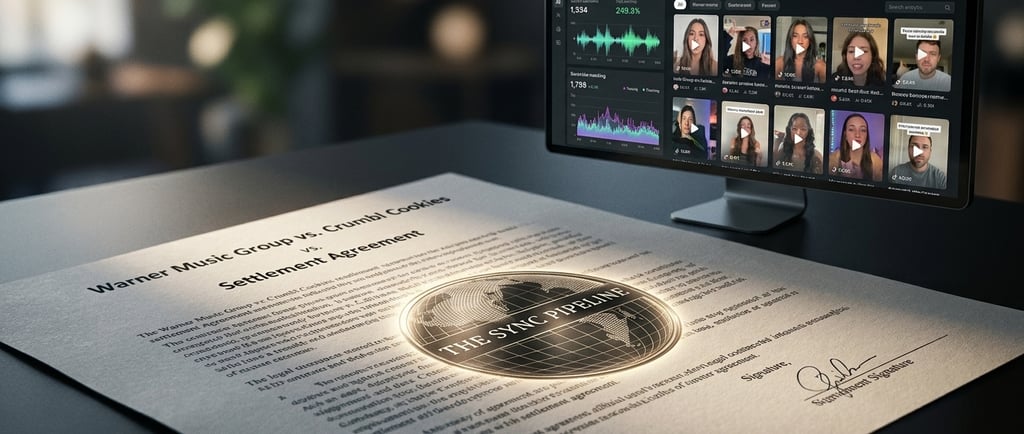
On May 26, 2026, the U.S. judicial system officially stayed the litigation between Warner Music Group (WMG) and the bakery chain Crumbl Cookies following a settlement agreement. This dispute, involving the unauthorized use of 159 tracks in promotional TikTok and Instagram videos, ended with the brand's capitulation before trial. For the B2B market, this outcome marks the end of the "gray area" for brands: commercial synchronization on social media is no longer an option, but an infrastructural obligation.
Klem Loden
5/28/20262 min read
The End of a 13-Month Standoff
After more than a year of litigation initiated in April 2025, Warner Music Group and Crumbl Cookies informed the Utah federal court that they had reached a settlement in principle. Although the financial terms remain confidential, the stakes were massive: WMG was claiming up to $150,000 per infringement, bringing the theoretical risk for the brand to over $23.8 million. This suspension of proceedings, enacted by the court on May 26, 2026, confirms that when faced with Major label firepower and clear digital evidence, a financial settlement has become the only way out for imprudent companies.
The Mirage of Built-in Music Libraries
The Crumbl case illustrates a critical failure of Sync Literacy within marketing departments. The defense often rested on the idea that if a song is available in the TikTok or Instagram library, it is free to use. However, as this settlement serves to remind, those licenses are strictly limited to personal use. As soon as a brand uses a track to promote a product, even via an official account, it shifts into the Commercial Sync regime. By using hits from artists like Dua Lipa or Bruno Mars without an explicit license, Crumbl transformed its social media presence into a major financial liability.
AI and Monitoring: Total Pipeline Surveillance
This settlement is part of a broader wave of enforcement led by Majors (Sony, UMG, WMG) against entities such as DSW, PacSun, and Marriott. At The Sync Pipeline, we analyze these systematic settlements as the result of automated monitoring. Majors now utilize spectral detection tools to scan brand content in real-time. Imprudence is no longer just a strategic error; it is an anomaly immediately detected by the copyright holders' compliance bots.
Compliance as a Brand Asset
The Warner/Crumbl case proves that structural alignment is not just a catalog issue; it is a vital necessity for buyers. For brands, possessing "Sync Literacy" is no longer a luxury but a measure for asset protection. In 2026, the cost of a commercial license is negligible compared to the price of a settlement imposed by a Major. A brand’s communication pipeline security now depends on its ability to certify that every second of music used is administratively unassailable.