
Total Verticalization: Bose Bypasses the Sync Market
In June 2026, Bose crossed an industrial Rubicon by announcing the launch of Bose Studios and its own record label, Bose Records. By moving beyond its historical role as a hardware manufacturer to become a full-scale content producer, the audio giant is imposing a model of total verticalization. This article analyzes how this strategy aims to eliminate the friction of licensing costs and represents a direct threat to the traditional advertising synchronization ecosystem.
Klem Loden
6/22/20262 min read
Bose Studios: The Brand as a Sovereign Media Entity
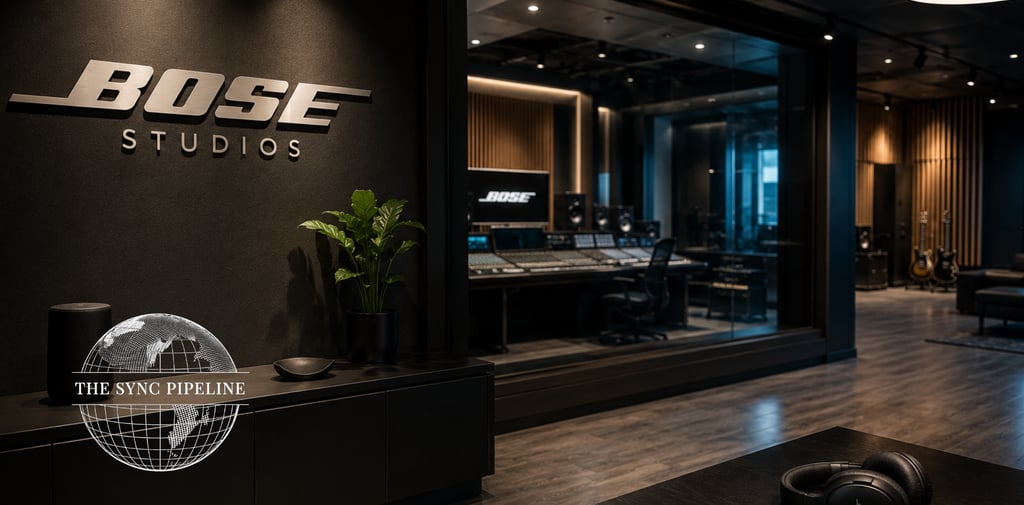
The announcement by CMO Jim Mollica in June 2026 marks the end of the era of transactional marketing for Bose. By establishing Bose Studios, the company is no longer merely seeking to place its products within culture; it is producing the culture itself. This entertainment division, which is actively recruiting from the film, television, and podcasting sectors, transforms Bose into a hybrid media entity. At The Sync Pipeline, we analyze this move as a direct response to audience fragmentation: to capture attention, Bose is choosing to own the entertainment infrastructure rather than purchasing increasingly expensive and ignored advertising space.
Bose Records: The "Internal Sync" Artifice
The launch of Bose Records is the centerpiece of this verticalization strategy. Although Bose claims it does not wish to compete with the Majors and allows artists to retain ownership of their masters, the B2B stakes are purely financial. By developing its own artists, Bose ensures unlimited, royalty-free access to a high-quality catalog for its global campaigns. This "internal synchronization" model bypasses complex and costly negotiations with third-party publishers. It is a paradigm shift: music is no longer an external acquisition cost, but an industrial component produced in-house.
A Threat to the Ecosystem: Short-Circuiting Agencies
This offensive by Bose represents a wake-up call for sync agencies and music supervisors. If major brands begin producing their own musical assets via proprietary labels, an entire segment of the prestige licensing market could evaporate. Bose’s message is clear: the structural alignment between the product (the headphones) and the content (the music) is more efficient when managed without intermediaries. For traditional players, survival will depend on the ability to offer added value that in-house brand studios cannot yet replicate: cultural rarity and editorial independence.
Toward an Industry of Captive Flows
Bose’s 2026 pivot confirms that mastering the pipeline is the new frontier of profitability. By integrating creation, production, and distribution, Bose secures its margins and strengthens its Sonic Signature without depending on market licensing rate fluctuations. For the Industrial Strategist, the Bose case proves that sovereignty is no longer limited to technological patents but now extends to the possession of creative flows. In this new landscape, brands no longer consume music; they become the factories that manufacture it.
References and Verified Sources:
Digital Music News: Bose Expands with the Launch of a Record Label and Content Studio (June 17, 2026)
Business Insider: Bose is becoming a media company and launching a record label (June 17, 2026)
New Industry Focus: Bose Launches Record Label and Content Studio to Bypass Ad Costs (June 18, 2026)
TopHit: Bose Enters the Music Business With New Record Label and Content Platform (June 18, 2026)