
The Music Tech Ouroboros: Why Infrastructure Has Devoured the Catalog
Industry activity in May 2026 confirms a systemic shift: the music market is no longer a content industry, but a plumbing industry. According to the latest update of the Music Tech Ownership Ouroboros by Cherie Hu, we have entered a phase of “re-consolidation” where the systems that organize and price music (the pipeline) take precedence over intellectual property. For the Industrial Strategist, this movement signifies that value has migrated from copyright to the control of data infrastructure.
Klem Loden
5/27/20262 min read

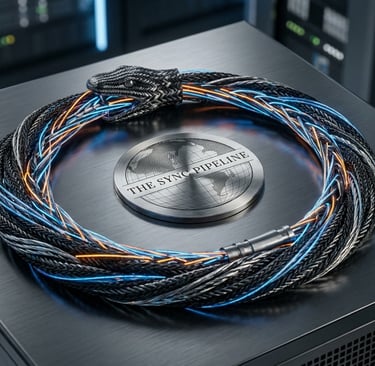
The Ouroboros Cycle: Total Pipeline Integration
The Ouroboros concept illustrates a feedback loop where the financial interests of Majors, tech platforms, and private equity merge to lock down the market. The most significant move remains the finalization of the Downtown Music Holdings acquisition by Universal Music Group (UMG) for $775 million via its subsidiary, Virgin Music Group. By absorbing pillars of independent infrastructure such as FUGA, CD Baby, and Curve, UMG no longer just owns rights; the Major now controls the distribution and accounting systems upon which its own competitors rely. In 2026, the Ouroboros is complete: the market leader owns both the source and the flow.
From Catalog Ownership to System Control
Cherie Hu’s analysis highlights a critical point for synchronization: owning the rights to a track has become secondary to owning the system that activates it. Entities like Songtradr have spent recent years assembling a complete vertical stack under the MassiveMusic umbrella, integrating 7digital (delivery platform), Musicube (AI and metadata), and Big Sync Music (licensing). This verticalization means that power belongs to whoever holds the instant clearance tools and matching algorithms. In 2026, the pipeline dictates the catalog's value, not the other way around. As Paul Langworthy (CRO of Songtradr) points out, the goal is to remove "technological roadblocks" to transform music into a fluid financial asset.
Data Management as the New Scarcity Lever
The Ouroboros manifesto reminds us that every industry problem traces back to a "meta-problem": metadata. Whether licensing catalogs for AI or micro-sync, the absence of clean data immediately breaks the revenue pipeline. This is where companies like Duetti or Create Music Group step in. Backed by funds such as The Raine Group or Blackstone, their strategy is no longer simple rights accumulation, but the application of modern data infrastructure to undervalued catalogs. They transform music into an interoperable asset, making traditional management models obsolete through sheer technical superiority.
Sovereignty Through Structural Alignment
Faced with this technological Ouroboros, the only defense for independent structures is total mastery of their own data pipeline. Independence is no longer defined by artistic freedom, but by infrastructural sovereignty. At The Sync Pipeline, we maintain that technical alignment is the sole bulwark against value dilution. In 2026, to survive the Ouroboros, one must stop seeing music as art and begin managing it as a software asset within a globalized and ultra-consolidated ecosystem.
References and Verified Sources:
Water & Music (Cherie Hu): Music tech ownership ouroboros, 2026 edition
Digital Music News: Songtradr’s Paul Langworthy on MassiveMusic Consolidation and Infrastructure
Music Business Worldwide: UMG/Downtown Deal: Impact Analysis on the Independent Sector
Music Ally: Breaking down the arguments around VMG's Downtown Music acquisition