The “Data War”: Why Talent Loses to Metadata in 2026
The manifesto published by Synchtank in May 2026 is a seismic shift for passive catalogs: metadata is no longer an administrative accessory; it is the “Main Stage” of the industry. In 2026, the performance gap between majors and independents is no longer measured by artistic quality, but by infrastructure mastery. This article analyzes how “Dark Data” siphons 30% of independent catalog revenue and why asset centralization has become the sole survival strategy.
Klem Loden
5/23/20262 min read
Metadata is the Main Stage: The End of the Creative Illusion
Synchtank’s conclusion is clear: if the song is the star, metadata is the stage upon which it stands. Without an impeccable data infrastructure, the performance simply does not happen because no supervisor can find the track. In 2026, we have moved from the era of the “creative pitch” to that of “search efficiency.” A catalog that cannot be filtered by BPM, mood, or clearance status in less than 30 seconds is an invisible catalog. Talent has become a commodity; data, however, has become the lever of scarcity.
The Hidden Cost of “Dark Data”: 30% of Revenue Evaporated
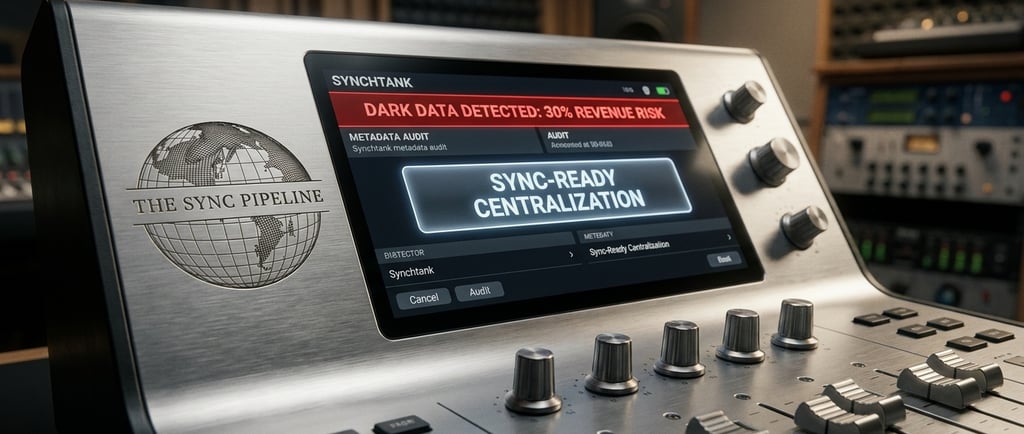
One of the most critical points of the manifesto concerns “Dark Data”, invisible, erroneous, or unusable metadata that pollutes digital files. According to Synchtank’s performance analysis, independent catalogs lose an average of 30% of their potential revenue due to this opacity. It is not a lack of opportunities, but a technical inability to seize them. Every remix not linked to its original version, every cover with non-centralized splits, and every edit with stems scattered across different hard drives constitutes a massive capital leak.
Validation of the Sync-Readiness Audit
At The Sync Pipeline, we have maintained since day one that the Sync-Readiness Audit is the sole bulwark against this depreciation. Synchtank has just validated this framework by publishing its own industrial checklist. Version management (Remixes, Edits, TV Tracks) must be automated and centralized. Centralization is no longer a logistical luxury; it is a market necessity. In a saturated ecosystem where 100,000 tracks are uploaded every day, the “cleanliness” of your catalog is your only competitive advantage. An audited catalog is a circulating catalog; a disorganized catalog is a dead asset.
Centralization as a Weapon of War
The “Data War” is only beginning. For independent publishers and labels, the message is clear: stop looking for the next hit and start cleaning your files. In 2026, the sovereignty of a catalog rests on its algorithmic visibility and legal security. Adopting a centralized management platform and submitting assets to a rigorous compliance audit is the only way to transform your “Dark Data” into real revenue streams. Operational reliability is now the only currency that matters in Hollywood and London.
References and Verified Sources:
Synchtank: The Metadata Checklist: Why Metadata Is the Main Stage (May 13, 2026)
Synchtank Core: Setting your foundation for managing and growing your music catalog (May 2026 Update)
Music Business Worldwide: Synchtank reports on why metadata is the foundation of music ROI in 2026 (May 15, 2026)
Variety Intelligence: Dark Data: The Hidden Financial Drain on Independent Music Catalogs (May 20, 2026)