Rights Architecture: The Udio Pivot and Master/Publishing Parity
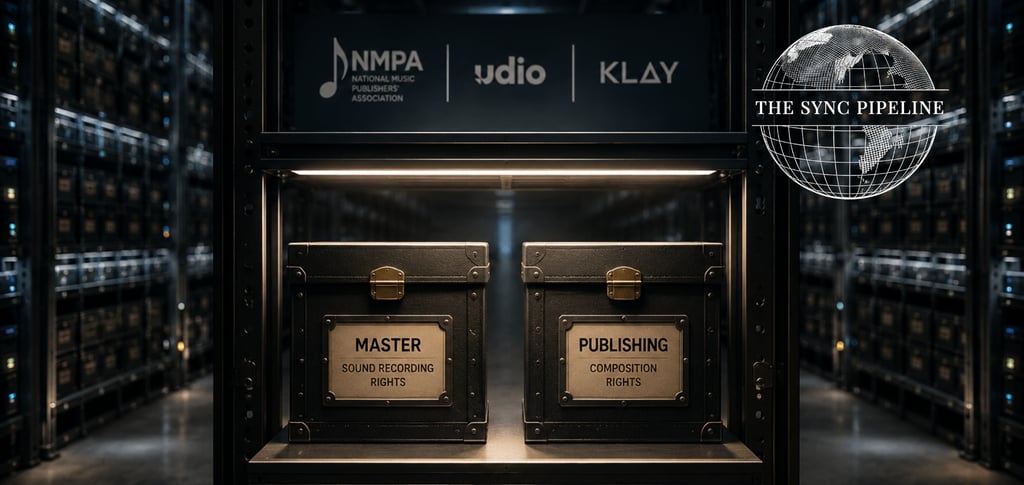
On June 10, 2026, the National Music Publishers’ Association (NMPA) reached a historic milestone by announcing licensing agreements with AI platforms Udio and KLAY. For The Sync Pipeline, the significance of this deal transcends the contractual framework: it is the birth certificate of absolute value parity between the composition (Publishing) and the sound recording (Master) within the AI economy. By imposing this standard, the NMPA is redefining royalty architecture and mandating a new metadata standardization for training pipelines.
Klem Loden
7/1/20262 min read
The End of Historical Imbalance: 50/50 for AI
For decades, the music industry has operated under a structural imbalance where the sound recording (the Master) often captured a higher share of value than the composition (the Publishing). At the NMPA Annual Meeting, David Israelite shattered this paradigm by announcing that the deal with Udio is the first to “value songs as much as, if not more than, sound recordings” for model training. This AI-Training Royalty Architecture imposes an equal-split norm, recognizing that a work’s creative DNA is as crucial to machine learning as its sonic texture.
KLAY and the Model of Prior Consent
The agreement in principle with KLAY highlights another sovereignty requirement: the shift from “mass piracy” to “licensing by design.” Unlike first-generation models trained in opacity, KLAY is deploying a Large Music Model (LMM) trained exclusively on licensed music. This preventive approach validates the Operational Sync Literacy (OSL) framework: a catalog’s value no longer lies in its raw volume, but in its ability to be indexed with explicit consent and binary clarity regarding its associated rights.
Infrastructure Consequence: In-DNA Parity Markers
For publishers and rights holders, this pivot mandates an immediate update to metadata infrastructure. As parity becomes the contractual norm, audio files must now integrate specific parity markers for AI pipelines. It is no longer enough to have a “Sync-Ready” file; the asset must be capable of communicating its split instructions automatically to the licensing agents of generative platforms. Standardization is no longer limited to emotional tagging; it now extends to the financial architecture of the file itself.
Composition as a Sovereign Asset
The NMPA’s offensive transforms musical composition into a premium asset within the AI pipeline. By securing this value parity, David Israelite is protecting the sovereignty of songwriters against automation. For The Sync Pipeline readers, the message is clear: the structural alignment of your catalogs is your only defense. In a market where the buyer is an algorithm, your metadata precision and the strength of your “Chain of Title” are the sole guarantors of your financial parity.