
K-Pop Expansion Fund: The South Korean State Industrializes the Sync Offensive
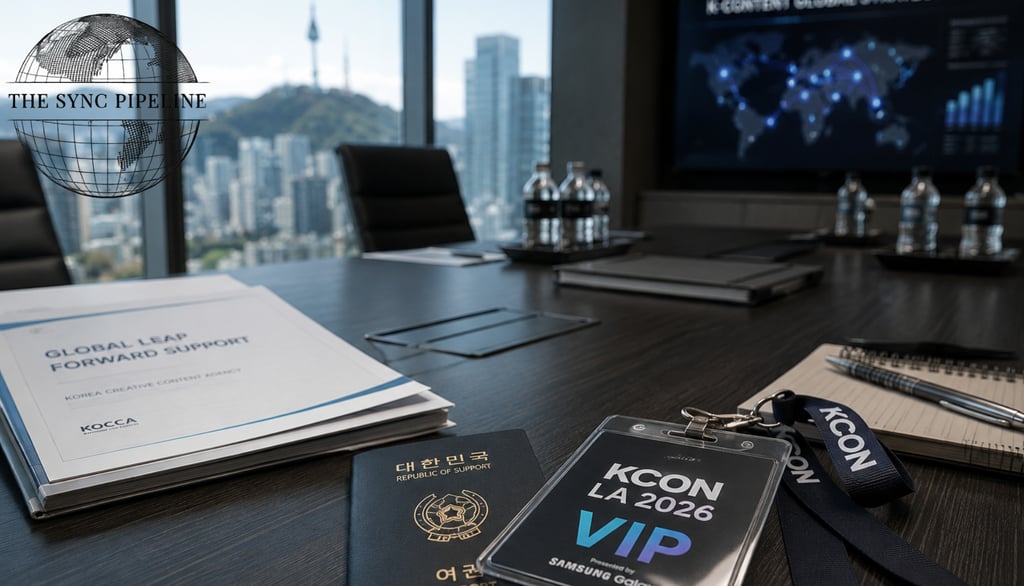
On June 16, 2026, the South Korean government took a major step in its cultural export strategy with the launch of the "Global Leap Forward Support" project. Armed with a $2.2 million budget, this fund does not target the "Big Four" giants; instead, it injects capital directly into 10 independent agencies to saturate Western markets. This article analyzes how this state-led financial lobbying transforms talent into a massive export infrastructure, designed to force Korean catalogs into the synchronization pipelines of Los Angeles and London.
Klem Loden
6/20/20262 min read
Funding the “Sync Highway”
The project, managed by the Korea Creative Content Agency (KOCCA), marks a departure from traditional artistic subsidies. By allocating up to 300 million won annually to mid-sized structures such as Rescene or Xikers, Seoul is directly financing export engineering. Unlike the majors that rely on their own internal funds, these independent agencies now receive state-backed leverage to produce content, albums, music videos, and showcases, whose technical standards are specifically calibrated for the U.S. market. At The Sync Pipeline, we analyze this as the construction of a "sync highway": the government is no longer merely promoting culture; it is financing the technical alignment of assets for Western music supervisors.
Combating Polarization via Financial Lobbying
Data cited by the Korean Ministry reveals a brutal disparity: in 2023, the "Big Four" (HYBE, SM, YG, JYP) spent an average of 43.1 billion won on production, compared to just 1.49 billion won for independents, a 29-to-1 ratio that created a structural bottleneck. The $2.2 million fund aims to break this monopoly by providing independent labels with the means to compete on the ground of "Sync-Readiness." By financing high-budget music videos and international tours (such as those planned for KCON LA), the South Korean state ensures its catalogs are no longer perceived as exotic niches, but as viable and omnipresent production solutions for global streaming platforms.
The Industrialization of Export: Beyond Talent
The impact on the synchronization sector is systemic. This fund allows agencies to hire international marketing teams and standardize their metadata to meet the stringent requirements of Burbank and New York. We are witnessing a profound mutation: musical export is no longer a matter of "artistic discovery," but a funded saturation operation. By injecting public capital into export-oriented promotion and production, South Korea is transforming its labels into precision components for the global audiovisual pipeline. For L.A. music supervisors, this means a massive influx of Korean content where the rights are clear, production quality is guaranteed, and visibility is already pre-paid by Seoul.
Sync as an Instrument of Sovereignty
The launch of the "Global Leap Forward Support" confirms that South Korea treats music as a strategic infrastructure. In 2026, global dominance is no longer won solely through streaming algorithms, but through the control of synchronization catalogs. By financing direct access to Western markets for its independent agencies, the Korean state is establishing a financial lobbying model that could force Western majors to re-evaluate their own catalog management. The lesson for the industry is clear: the future of export belongs to those who industrialize their licensing pipeline.
References and Verified Sources:
Music Business Worldwide: South Korea launches $2.2M fund to help indie K-Pop agencies expand overseas (June 18, 2026)
Music Ally: South Korean government launches fund for smaller K-Pop firms (June 18, 2026)
The Korea Times: Korea launches $2.2 mil. fund to boost indie K-pop labels (June 16, 2026)
VnExpress International: South Korea launches $2.2M fund to support independent K-pop agencies (June 17, 2026)