
From Detection to Decision: AI as Judge and Jury of Your Catalog
In May 2026, Cyanite redefined the standards of catalog auditing by launching its “From Detection to Decision” protocol. While AI detection was previously treated as a technical curiosity, it has now become an essential commercial arbitration tool. By transforming audio signals into legal risk scores, Cyanite enables publishers to actively filter assets eligible for high-stakes synchronization. This article analyzes how diagnostic AI is establishing itself as the new arbiter of market value for independent repertoires.
Klem Loden
5/26/20262 min read
The Pivot Toward Decision Support
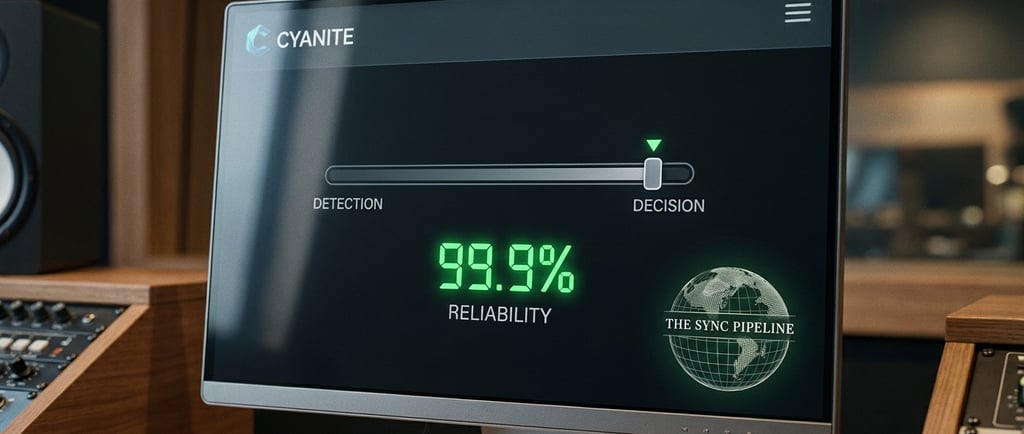
AI detection has long been perceived as a simple game of technological cat-and-mouse. On May 7, 2026, Cyanite officially broke this paradigm by clarifying its mission: the objective is no longer binary classification, but operational decision support. For a music supervisor in Los Angeles, knowing that a track contains AI is only the first step; the real challenge is deciding whether that asset can be licensed without risk to a brand or a studio. Cyanite now treats the audio signal not as an emotion, but as a proof of compliance.
Reliability Scoring: The End of the Legal Wild West
The core of this mutation lies in the shift from semantic tagging to Reliability Scoring. According to Roman Gebhardt, CAIO of Cyanite, the system is now calibrated to minimize false positives to a rate of 0.01%, as a detection error on a human artist is a “reputational time bomb” that distributors can no longer afford to risk.
In 2026, Cyanite’s AI acts as a customs officer at the entry of the synchronization pipeline. A high detection score no longer just means “machine-generated”; it means “uninsurable copyright risk.” Conversely, a low score becomes an indispensable certificate of “cleanliness” for the most demanding briefs, particularly those from streaming platforms that now impose strict non-AI clauses.
AI as the Arbiter of Commercial Value
At The Sync Pipeline, we observe that this shift fully validates our Sync-Readiness Audit framework. Cyanite’s tools transform catalog management into a rigorous exercise in Risk Management. An independent publisher can now subject their catalog to automated arbitration to identify “toxic” assets, those with murky rights traceability or signals exhibiting markers of unlicensed models like Suno.
This decision-making capability changes the very nature of catalog valuation. In 2026, value is no longer correlated with the number of tracks, but with the proportion of assets that have successfully passed the AI decision filter. Data becomes the final arbiter: a track may be artistically brilliant, but if it lacks Cyanite’s seal of technical reliability, it is de facto excluded from premium synchronization pipelines.
Transparency as the Only Growth Lever
Cyanite’s May 2026 manifesto is clear: anonymity has become the enemy of growth. In a saturated market, the ability to prove asset integrity via independent diagnostic tools is the only way to maintain buyer trust. For independents, adopting these decision tools is not a constraint; it is a survival strategy. In 2026, your catalog is not just heard by the human ear; it is judged by the compliance algorithm, and it is the latter that signs the check.
References and Verified Sources:
Synchtank (Synchblog): From Detection to Decision: How Cyanite Approaches AI-Generated Music (May 7, 2026)
Cyanite AI Blog: Why AI music detection is harder than it sounds - Decision Support Framework (May 6, 2026)
Music Business Worldwide: Cyanite launches AI music detection tool to help industry 'make informed decisions' (May 2026 Analysis)
Variety Intelligence Platform: AI Risk Management: Why Sync Agents are Turning to Detection Scores for Decision Making