
Why Most Sync Careers Plateau After the First Placements
Early placements feel like momentum. In reality, they often mark the beginning of a plateau. This article examines why many sync careers stall after initial success, and how systemic misunderstanding quietly replaces growth with repetition.
Klem Loden
2/5/20263 min read
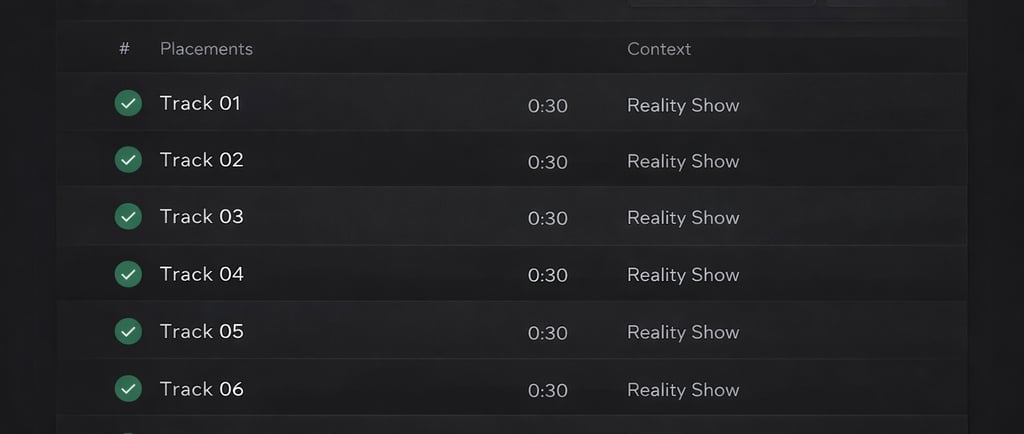
The first placements arrive quietly.
Sometimes they feel accidental. Sometimes they feel overdue. A cue lands in a show, a track makes it into a trailer, a supervisor replies with a brief thank-you. For many composers, this moment carries an implicit promise: now things start moving.
And for a short time, they do.
Emails pick up. Briefs circulate. Names get mentioned. There is a sense of entry, of having crossed an invisible threshold. Then, just as quietly, everything stabilizes. The work continues, but it stops compounding. The same types of placements repeat. The same projects come back. The same level of access remains.
This is the plateau.
Most composers interpret this phase emotionally. They assume momentum faded. They wonder whether the industry lost interest. They question their relevance, their positioning, sometimes even their talent. But what actually happens here is not a loss of attention. It is a failure of structural evolution.
Early placements do not mean the system has fully integrated you. They mean the system tested you.
Initial success in sync usually reflects a narrow compatibility: one style, one brief category, one editor relationship, one catalog context. The pipeline discovered that you could solve a specific problem under specific conditions. What many composers miss is that this does not automatically expand into broader trust.
The industry does not generalize from isolated wins. It compartmentalizes.
A placement proves that one asset worked once. It does not prove that your catalog behaves reliably across multiple contexts. It does not prove that your delivery remains consistent under pressure. It does not prove that post-production can reuse your material without friction. And it certainly does not prove that your workflow scales. So the system keeps you where it first encountered you.
This is why so many careers flatten after the early wins. Not because opportunity disappears, but because the composer continues operating at the same level of system compatibility that produced the first placements, without realizing that sustained growth requires a different mode entirely.
At this stage, many professionals double down on creativity. They try to write stronger tracks. More emotional cues. Bigger arrangements. They refine their sound, polish their mixes, chase originality. Artistically, this can be productive. Operationally, it changes very little. Because the plateau is not creative. It is structural.
What actually unlocks the next level in sync is not better music in isolation. It is expanded usability. It is editorial predictability. It is catalog coherence. It is behavioral consistency. It is becoming someone whose assets move easily across timelines, whose files behave under revision, whose communication remains neutral under stress, whose deliveries anticipate downstream needs.
In other words, growth happens when you stop being a contributor and start becoming infrastructure.
This shift is subtle, and that’s precisely why it’s missed.
The system does not announce it. There is no new contract that says “you are now scalable.” There is no ceremony for becoming reusable. Instead, access widens quietly. Your tracks get pulled by people you’ve never spoken to. Your catalog starts resurfacing in contexts you didn’t pitch. Your name circulates without you pushing it.
Until that happens, you remain localized.
Many composers mistake activity for progression during this phase. They stay busy. They keep submitting. They accumulate placements. But the surface movement hides the deeper truth: nothing is compounding.
The pipeline is using them, but not expanding them.
The uncomfortable reality is that early success often masks stagnation. It creates the impression of arrival while freezing development at the level of first compatibility. Without a deliberate shift toward system-wide alignment, careers settle into loops instead of trajectories. This is why the second phase of sync is harder than the first.
Getting in requires talent and opportunity. Moving beyond requires structural awareness.
The plateau after initial placements is not a failure. It is a signal. It tells you that the system has accepted you provisionally, but not yet integrated you broadly. The difference between composers who stall and composers who scale is not artistic intensity. It is their willingness to redesign how they function inside the pipeline.
In sync, momentum doesn’t come from repeating what worked. It comes from becoming usable in more places, by more people, under more conditions.
Sync Publishing LLC — Wyoming, USA
Registered Office: Sheridan, Wyoming
© 2026 Klem Loden — All rights reserved.
All content, programs, and materials are protected under U.S. copyright law.
Professional advisory and structural alignment for global music catalogs and publishers.
Independent consulting — not a placement agency and not a publishing service.