Why “Good Music” Is No Longer Enough in 2026: Infrastructure Is Your Real Product
Industry analyses from May 2026 confirm a brutal shift in the synchronization market: artistic quality has been relegated to a secondary requirement, superseded by usability and operational readiness. As established by Aaron Davison, the market no longer rewards raw talent alone; it rewards those who eliminate friction. For music supervisors, the Clean Rights standard is the new line in the sand. This article analyzes why your catalog must now be treated as an industrial component rather than a simple artistic work.
Klem Loden
5/14/20262 min read
The Shift from Brilliance to Solutions
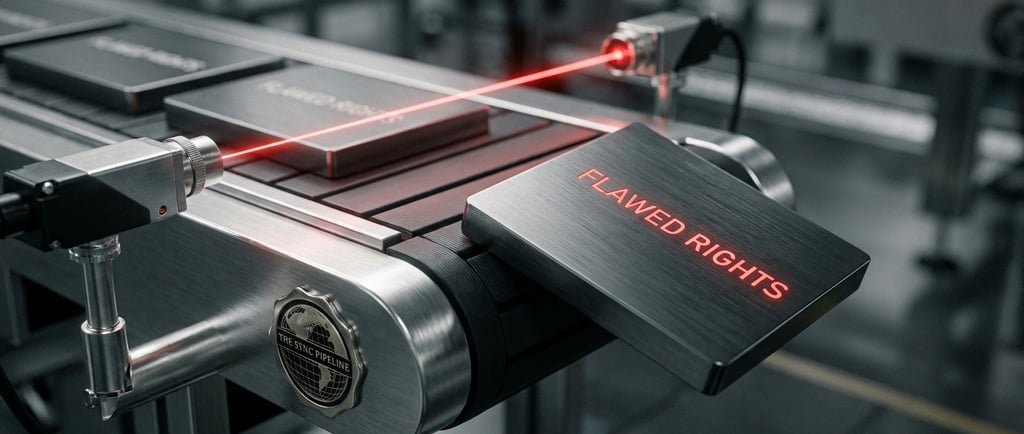
In the 2026 synchronization landscape, the volume of available content has reached a saturation point where quality is now a baseline assumption rather than a competitive advantage. According to recent deep-dives by Aaron Davison, music supervisors are no longer hunting for creative brilliance, but for answers to specific production problems. A track that is objectively powerful but structurally complex or legally ambiguous is systematically bypassed. The industry has reached a stage where an excellent song requiring even the slightest negotiation or legal clarification is perceived as a defective part in the assembly line. In 2026, usability is the sole metric determining whether music actually moves from a hard drive to a screen.
Infrastructure as the Core Product
The fundamental pivot for independent publishers this year lies in recognizing that their true product is not the music itself, but the operational infrastructure that delivers it. At The Sync Pipeline, we define this as the transition from artistic talent to industrial reliability. As noted in recent Variety Intelligence Platform studies on asset vetting, supervisors are increasingly acting as quality control engineers. They demand specified music assets that are not only creatively viable but structurally compliant. This implies instant emotional legibility, mixing designed specifically for dialogue, and encoded metadata that allows for an immediate binary “yes” during the validation phase.
The “Clean Rights” Mandate: Zero-Tolerance for Friction
The Clean Rights standard is the direct result of tightening post-production timelines. In 2026, administrative time has become the most expensive variable for studios. If a track requires more than a single email exchange to confirm split shares or verify the chain of title, it is deemed industrially non-viable. Davison’s latest reports emphasize that operational readiness now equals a total absence of friction. A catalog presenting even a 1% legal risk, whether through an uncleared sample or an unconfirmed co-writer, will be rejected before the creative director even hears the first note. In this high-velocity economy, legal clarity is the only true Eldorado for independents.
The New Barrier to Entry
The era where “good music” constituted a sufficient commercial argument is over. In 2026, the barrier to entry is no longer talent, but structural alignment. The catalogs that win are those that stop selling vibes and start providing infrastructure. By adopting the Clean Rights standard and focusing on asset usability, independent publishers are not just selling music; they are securing the production pipeline. In the modern sync economy, your infrastructure is your product, and its reliability is your only currency.
References and Verified Sources:
Medium (Aaron Davison): Why “Good Music” Isn’t Enough for Sync Licensing in 2026 (May 2026)
LinkedIn (Aaron Davison): How To Know If Your Music Is Actually Ready For Sync Licensing (May 2026 Update)
Variety Intelligence Platform: The Industrialization of Creative Assets: New Vetting Standards for Production Music