
Why Good Music Gets Buried Inside Bad Catalog Architecture
In sync, strong music often fails for reasons that have nothing to do with sound. This article examines how playlists, metadata, naming, and visual structure quietly sabotage otherwise usable tracks, and why catalog architecture, not musical quality, determines what actually gets pulled.
Klem Loden
1/24/20263 min read
Why Good Music Gets Buried Inside Bad Catalog Architecture
One of the most frustrating experiences for composers working in sync is deceptively simple. They know a track is good. Feedback has been positive. The music works. And yet it never gets pulled.
In most cases, the problem is not the music. It is the architecture surrounding it.
In professional sync environments, music does not exist as individual tracks waiting to be discovered. It lives inside systems. And systems decide what survives. When the architecture is weak, even excellent music becomes effectively invisible.
Architecture Determines Visibility
Catalogs are not passive containers. They are active decision environments. Every structural choice either accelerates routing or introduces friction. When friction appears, the system does not negotiate. It moves on.
This is why good music so often disappears without explanation. It is not rejected. It is suffocated.
When Playlists Stop Working
Playlists are frequently misunderstood as aesthetic groupings. In reality, they are operational tools designed to answer a single question under pressure: can this solve my editorial problem right now.
When playlists lack functional clarity, they become unusable. Shifting moods, inconsistent energy levels, emotional ambiguity, or groupings based on genre rather than use case force the listener to think. The moment thinking is required, momentum is lost.
Editors do not scroll patiently. They do not explore for context. They do not discover. They grab the first obvious solution or they leave. A single unclear playlist can bury ten perfectly usable tracks without ever touching the music itself.
Metadata Is Routing, Not Description
Metadata is often treated as descriptive language. In sync, it is instructional infrastructure. Tags do not exist to explain what the music is. They exist to define how it can be used, retrieved, and deployed under pressure.
When tags become poetic, emotionally ambiguous, stylistically redundant, or internally inconsistent, routing collapses before listening even begins. From a pipeline perspective, incoherent metadata introduces risk. If a track cannot be reliably retrieved when time is scarce, it will not be retrieved at all.
Good music with bad metadata is functionally mute.
How Naming Erodes Trust Before Playback
Track names are scanned long before audio is played. Naming is one of the fastest credibility filters in sync, and one of the easiest ways to lose trust instantly.
Titles overloaded with metaphor, clever wordplay, internal references, or emotional language disconnected from actual use signal the same thing. The composer is not thinking downstream. Even when the music is strong, trust erodes before playback begins. Once trust drops, routing stops.
This is not about creativity. It is about legibility.
Why Visuals Matter More Than Composers Expect
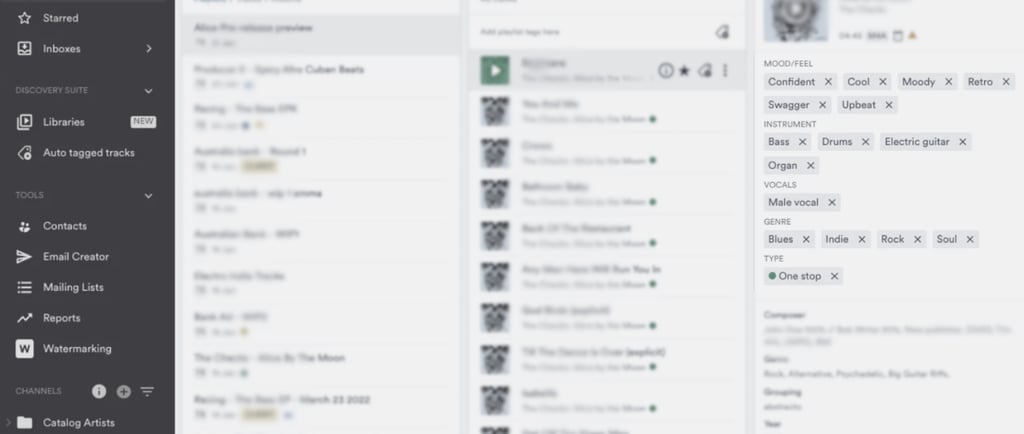
Visual presentation is often dismissed as decoration. In reality, visuals frame credibility. Covers, thumbnails, page layouts, and even screenshots do not sell music. They establish seriousness.
Weak visuals communicate uncertainty. They suggest amateur positioning, lack of editorial awareness, and misalignment with professional environments. Strong visuals do not need to be beautiful. They need to reassure the viewer that this asset belongs inside a real pipeline.
Editors and publishers are not looking for style. They are looking for signals of reliability. When visuals feel off, the catalog feels unsafe, regardless of how good the music is.
Why Architecture Beats Talent
In sync, catalogs are not evaluated track by track. They are evaluated as systems. Weak architecture creates cognitive friction. It slows decisions, increases uncertainty, requires explanation, and demands attention.
Under pressure, anything that demands attention is eliminated.
This is why average music inside a clean, readable, predictable system often outperforms excellent music trapped inside a chaotic one. The system rewards what moves smoothly, not what asks to be understood.
The Structural Conclusion
Good music does not fail in sync because it lacks quality. It fails because it is buried inside environments that make it hard to see, hard to trust, and hard to reuse.
Inside real pipelines, architecture consistently beats artistry.
If the system around your music does not work, your music never gets the chance to.
Sync Publishing LLC — Wyoming, USA
Registered Office: Sheridan, Wyoming
© 2026 Klem Loden — All rights reserved.
All content, programs, and materials are protected under U.S. copyright law.
Professional advisory and structural alignment for global music catalogs and publishers.
Independent consulting — not a placement agency and not a publishing service.