
The Majors vs. Suno Standoff: The Distribution Model Deadlock
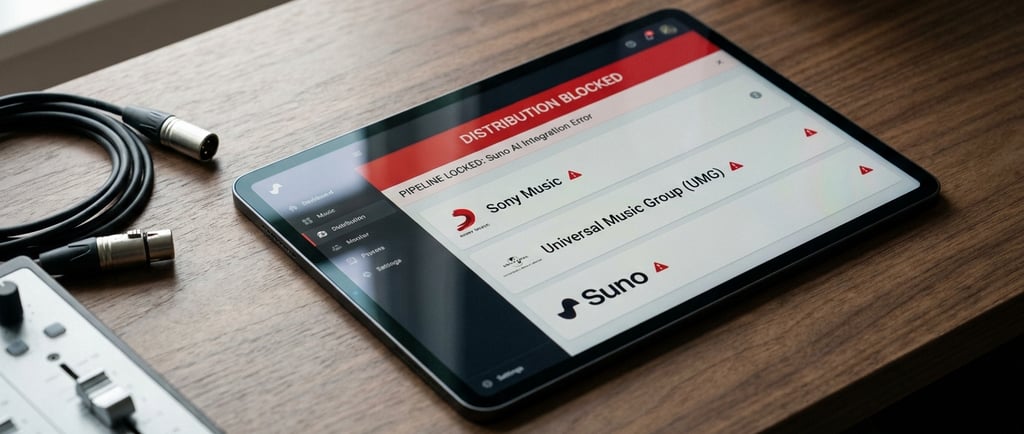
In April 2026, licensing negotiations between industry giants Sony Music, Universal Music Group (UMG), and the generative AI platform Suno reached a breaking point. While public debate centers on copyright, the true battlefield is infrastructural. Majors are demanding the containment of AI-generated content within closed ecosystems (“Walled Gardens”), while Suno advocates for open distribution. This is an analysis of a pipeline war where the control of the vessel has become more valuable than the content itself.
Klem Loden
5/1/20262 min read
The $150,000 Impasse: Moving Beyond Legal Settlements
While Warner Music carved a path with a licensing deal in late 2025, Sony and UMG are maintaining a hardline stance. Reports cited by the Financial Times indicate “no path forward” under Suno's current proposal. The deadlock is no longer about damages for model training, which can reach $150,000 per work under RIAA guidelines, but about the final destination of the flux. For the Majors, AI must not be an exportable creative tool, but a locked-in platform feature.
Infrastructure vs. Creation: The Strategy of Containment
Universal’s position is a masterclass in infrastructure strategy. UMG demands that songs generated by AI remain confined within the Suno application. This follows the model already established with Udio (Suno's primary competitor), where users are prohibited from downloading or exporting their creations. By banning exportation, labels protect the global distribution pipeline from being saturated with "slop", mass-generated AI music, that would dilute royalty pools on platforms like Spotify and Apple Music. The message is clear: you can play with our assets to create, but you cannot own the distribution channel.
Suno and the Open Pipeline Rebellion
Conversely, Suno, valued at $2.45 billion following its late 2025 funding round, rejects this “closed garden” model. For Suno, the value lies in user autonomy and the ability to distribute creations across the entire internet. This is where Operational Sync Literacy becomes crucial: Suno is attempting to build a parallel distribution pipeline, while labels are fighting to maintain their role as the exclusive gatekeepers of the global network. To accept Suno’s model would be, for the Majors, to surrender infrastructure management to a tech startup.
The Risk of “Administrative Toxicity”
For music supervisors and sync agencies, this deadlock creates a dangerous legal gray area. AI-generated content that "escapes" the platform without a clear distribution agreement becomes "administrative toxins" for any production pipeline. As highlighted by the Music Business Association report on digital asset management, the lack of distribution traceability makes these works unusable for major brands. Pipeline control is not just about power; it is about industrial safety.
Distribution as the Final Stronghold
In 2026, music has become a commodity, but distribution remains a luxury. The Suno/Majors conflict proves that the ultimate strategic asset is no longer the song itself, but the protocol that authorizes its circulation. For independent catalogs, this battle underscores a fundamental truth: owning intellectual property is no longer enough. You must master the distribution infrastructure to ensure your assets are not just created, but are legally and technically capable of moving through tomorrow's pipeline.
References and Consulted Sources:
Financial Times: Suno’s licensing talks with major labels in limbo with ‘no path forward’ (April 7, 2026)
Music Business Worldwide: Negotiations between Suno and Major Labels hit impasse over distribution model (April 2026)
The Verge: Suno and major music labels reportedly clash over AI music sharing (April 2026)
RIAA: Record Companies landmark cases against Suno and Udio - Legal Update (2024-2026)
Music Business Association: Digital Asset Management and AI Distribution Standards (Q2 2026 Report)