
The Independent Giant: How the BMG-Concord Merger Redefines Catalog Scale
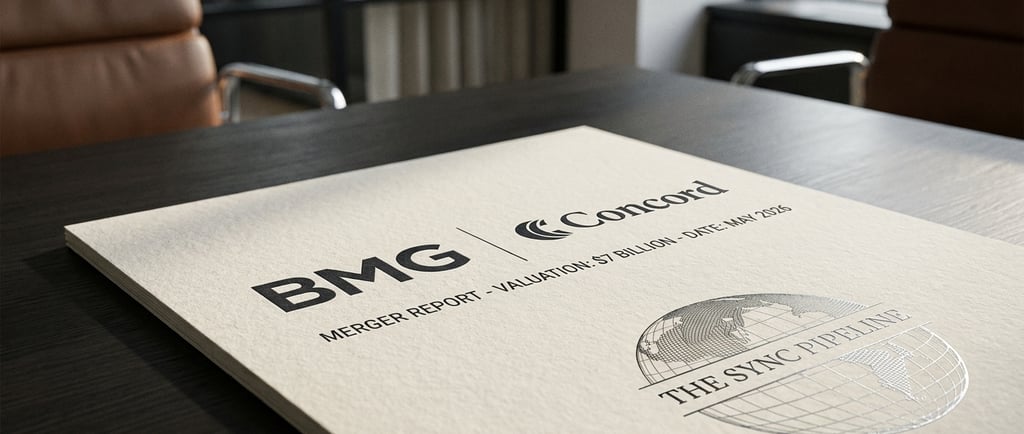
The recent announcement of the merger between BMG and Concord, a transaction valued between $6.6 billion and $7 billion, marks a definitive shift in the music industry’s power structure. By combining two of the world’s largest independent publishing and recorded music powerhouses, this new entity creates a "fourth major" in terms of operational scale. This article analyzes how this consolidation forces independent catalogs to reassess their own structural alignment to remain competitive in a market dominated by massive rights aggregators.
Klem Loden
5/7/20262 min read
The Birth of a New Global Powerhouse
The definitive agreement to combine the businesses of BMG and Concord is more than a financial headline; it is a strategic response to the increasing critical importance of rights ownership scale. Operating under the BMG name, the combined company will span music publishing, recorded music, and theatrical rights, positioning itself as the world’s leading independent music company. For music supervisors and studios, this merger creates a streamlined gateway to a vast repertoire, from legendary catalogs like Creedence Clearwater Revival and Phil Collins to frontline stars like Jelly Roll and Lainey Wilson.
Scale as a Strategic Infrastructure
At The Sync Pipeline, we monitor these shifts as evidence of the "Industrialization of Sync." The BMG-Concord merger highlights a fundamental truth: in 2026, scale is the primary lever for negotiating with global streaming platforms and major production houses.
Rights Aggregation: By managing over 125,000 artists and songwriters, the new BMG provides a "One-Stop" efficiency that mirrors the Big Three (Universal, Sony, Warner), significantly reducing administrative friction for licensees.
Investment Capacity: With a combined EBITDA ambition of $1.2 billion by the mid-term, the entity possesses the capital necessary to invest in cutting-edge AI tools and rights management technology, setting a new technical standard for the rest of the industry.
The Impact on the Independent Ecosystem
While BMG and Concord maintain their "independent" identity, their combined scale creates a high barrier to entry for smaller catalogs. The risk for independent labels is becoming invisible in a pipeline where supervisors prioritize high-volume, legally bulletproof vendors. To survive this consolidation, independent catalogs must adopt the same Operational Literacy as the giants: absolute metadata integrity, flawless stem architecture, and immediate contractual clarity. In 2026, you don't have to be a major to compete, but you must operate with the same industrial precision.
Reliability over Size
The BMG-Concord merger proves that the middle ground in music publishing is disappearing. You are either a massive aggregator of rights or a highly specialized, operationally elite boutique. As reported by Variety, this move is a resounding statement on the value of music publishing as a stable asset class. For the professional sync community, the message is clear: as the giants consolidate, your only defense is the structural perfection of your assets.
References and Consulted Sources:
Variety: BMG and Concord to Merge, Creating Fourth Major Music Company (April 28, 2026)
Billboard: BMG Parent Co. Bertelsmann to Buy Concord in Major Music Merger (April 2026)
BMG Official: BMG and Concord Combine to Create World's Leading Independent Music Company (2026)
The Hollywood Reporter: BMG and Concord Merge to Create New Music Giant (April 2026)