
The End of the Open Bar: Why Distributors Are Becoming Copyright’s New Customs Officers
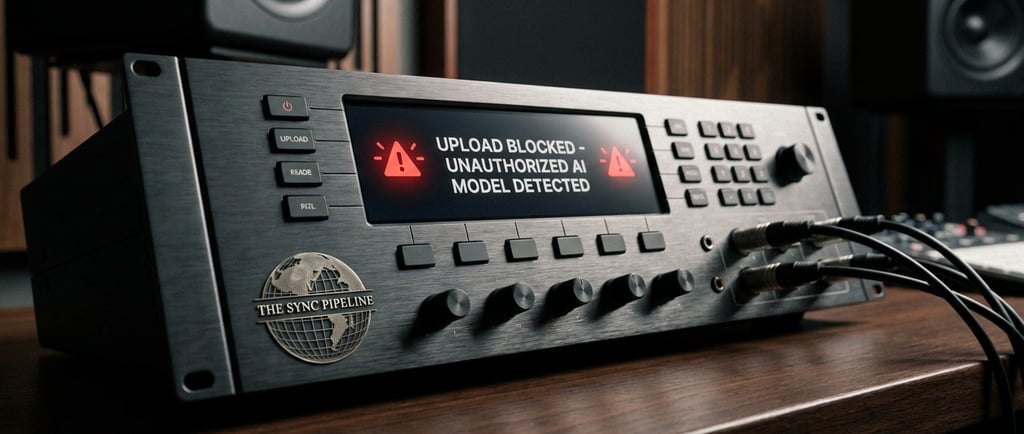
On April 30, 2026, Believe and its subsidiary TuneCore established a technological “red line” by systematically blocking the distribution of tracks generated by unlicensed AI models, described as “pirate studios” (Suno). Simultaneously, licensing agreements with platforms like ElevenLabs and Udio are defining a new perimeter of trust. For the synchronization industry, this move validates the Sync Pipeline framework of operational literacy: the market is now splitting between “certified clean” catalogs and legal gray zones that will be effectively banned from official pipelines.
Klem Loden
5/8/20262 min read
The Great Clean-up: 99% Detection Accuracy Against “Slop”
The announcement by Denis Ladegaillerie, CEO of Believe, represents a tectonic shift in industry operational standards. By deploying detection tools capable of identifying the specific origin of an AI model, Believe and TuneCore have ceased to be passive pipes. This decision responds to a stark financial reality: the “slop” generated by unlicensed models pollutes metadata and creates a massive litigation time bomb for every intermediary in the value chain.
Market Scission: “Clean” Catalogs vs. Gray Zones
At The Sync Pipeline, we view this announcement as the birth of a two-tier market:
The Institutional Segment (Clean): Catalogs utilizing either human intelligence or AI tools that have secured their training rights (ElevenLabs, Udio). These assets benefit from a fluid Chain of Title and are the only ones eligible for major synchronization budgets.
The Gray Zone (Banned): Productions stemming from pirate studios like Suno. While these tools remain popular among amateur creators, their distribution ban by independent leaders renders them de facto toxic for music supervisors. A track that cannot be officially distributed is a track that does not exist for Hollywood.
Operational Literacy as a Survival Filter
This new landscape confirms that catalog value in 2026 no longer lies in abundance, but in traceability. A music supervisor will never take the risk of placing a track whose distributor has already cast doubt on its provenance. By blocking these contents at the source (upload), Believe and TuneCore are protecting the integrity of the ecosystem. For publishers, adopting our technical compliance protocols is no longer an option; it is the only way to ensure assets remain within the “authorized” pipeline.
Toward a Global Industrial Standard?
Believe is now calling on streaming platforms (DSPs) to follow suit. If Spotify and Apple Music activate these detection filters, non-compliant catalogs will be effectively erased from the real economy. Synchronization, a precision market by definition, will be the first beneficiary of this clean-up: less background noise, increased legal security, and a value premium for creators who respect industrial standards.
Reliability is the New Currency
The end of anonymity for generative AI marks the return of editorial responsibility. In 2026, owning a “Sync-Ready” catalog means, above all, owning an “Audit-Ready” catalog. The red line drawn by Believe and TuneCore separates opportunists from professionals. In this new landscape, operational literacy is not just a skill; it is the entry fee for the industry of tomorrow.
References and Consulted Sources:
Music Business Worldwide: Believe and TuneCore are blocking distribution of Generative AI tracks made on 'pirate studios' like Suno (April 30, 2026)
Music Ally: TuneCore will not distribute AI tracks made on 'pirate studios' (May 1, 2026)
Unchained Music: Believe and TuneCore Draw the First Hard Line on AI Music Licensing (May 1, 2026)