
Royalty Dilution: How Algorithmic Fraud Indirectly Impacts Sync Budgets
The IFPI Global Music Report 2026 reports record-breaking revenues of $31.7 billion, yet the industry is on high alert. The explosion of streaming fraud, fueled by generative AI, is doing more than just polluting playlists; it is creating a systemic “royalty dilution” that indirectly impacts synchronization budgets. This article analyzes why the fight against fraud has become a priority for securing investments in new catalogs.
Klem Loden
5/6/20262 min read

The $31.7 Billion Paradox
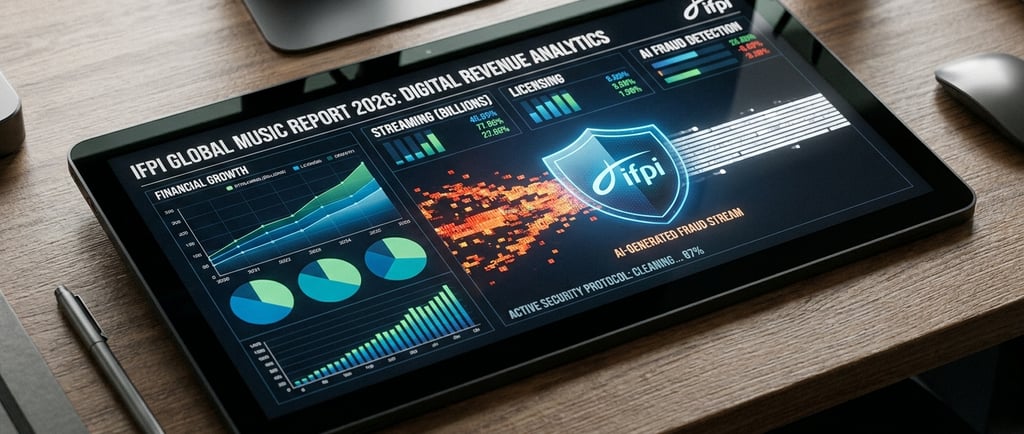
The annual report from the IFPI (International Federation of the Phonographic Industry), published this month, confirms the global music industry's financial solidity, driven by a 10.2% growth in paid streaming. However, behind this staggering $31.7 billion figure, the report sounds the alarm: algorithmic fraud, the use of bots to artificially inflate plays of AI-generated content, is diverting hundreds of millions of dollars from the legitimate royalty pool. For rights holders, this is not just a loss of income; it is a destabilization of the asset valuation model.
The Mechanism of Dilution: From Streaming to Sync
At The Sync Pipeline, we observe a direct domino effect. When streaming revenues are diluted by fraud, Major labels and large independents see their reinvestment capacity reduced. This financial contraction ripples through synchronization budgets in two primary ways:
Increased Administrative Costs: Labels must invest heavily in fraud detection tools and metadata cleaning, reducing the margins traditionally allocated to sync marketing.
Contractual Risk Aversion: The fear of “algorithmic toxicity” pushes studio legal departments to demand increasingly heavy proof of provenance, slowing down the fluidity of the licensing pipeline.
Generative AI as a Vector for Industrial “Slop”
The IFPI report emphasizes that generative AI is the primary engine of this new wave of fraud. By facilitating the creation of millions of tracks with zero artistic value (often termed “slop”), it allows fraudulent networks to saturate platforms. For the sync market, this translates into a massive increase in background noise. Any catalog unable to prove its human integrity and real listening history faces an automatic valuation discount. The legal clarity we advocate as a pillar of Operational Literacy becomes the only filter capable of separating valuable assets from algorithmic waste.
The Gatekeeper Response: Toward an “Artist-Centric” Model
In response to this report, platforms and collective management organizations are accelerating the transition toward “Artist-Centric” payment models, aiming to reward real, qualitative engagement. For sync professionals, this trend is an opportunity. It rewards catalogs that possess a genuine sonic identity and flawless traceability. As noted by Music Business Worldwide, the fight against fraud strengthens the position of publishers who treat their music as a serious industrial asset rather than a mere digital commodity.
Protecting the Pipeline Against Pollution
The IFPI 2026 report reminds us that growth is worthless without integrity. Algorithmic fraud is a pollution of the global revenue pipeline. For independent catalogs, the strategy is clear: total transparency regarding the provenance and authenticity of works is the only way to protect valuation. In a world diluted by fraud, operational reliability is the new gold standard for synchronization.
References and Consulted Sources:
IFPI Global Music Report 2026: State of the Industry (May 2026)
Music Business Worldwide: Streaming Fraud and AI Dilution - Impact Analysis (April 2026)
Billboard Pro: How Algorithmic Fraud is Reshaping Label Budgets (2026)
RIAA: Strategic Response to AI-Generated Streaming Fraud (Q2 2026 Update)
Synchtank: Music Catalog Valuation in the Era of Content Saturation