
Metadata Is a Decision-Making Tool, Not a Description
Metadata doesn’t explain music. It determines whether it moves. This article examines how metadata quietly governs routing, visibility, and reuse inside professional sync systems, long before anyone listens.
Klem Loden
2/4/20263 min read
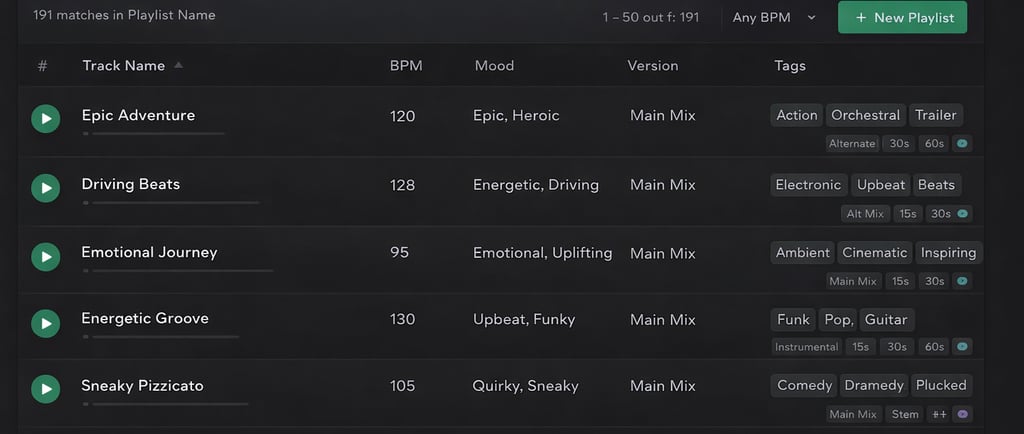
Most composers treat metadata as something that comes after the music, a technical layer, documentation, a necessary formality added once the creative work feels finished. From the outside, that makes sense. From inside professional sync environments, it reveals a misunderstanding of what metadata actually is.
Metadata is not descriptive. It is infrastructural.
Once music enters circulation, it stops behaving like a piece of art and starts behaving like material inside a system. It is no longer encountered in isolation. It is pulled into playlists, dropped into timelines, filtered through platforms, matched against briefs, compared under pressure, reused months later in entirely different contexts. Metadata is what allows that movement to happen without human intervention at every step.
Editors do not browse catalogs the way listeners browse playlists. They are solving immediate problems inside locked timelines. Supervisors are not exploring emotional landscapes. They are managing legal exposure while assembling deliverables. Libraries are not curating collections. They are maintaining inventories that must remain stable under volume. In that environment, metadata becomes the first decision-maker.
Before anyone presses play, the system is already asking operational questions. Can this asset be retrieved quickly. Does it fit the usage category. Is it structurally compatible with what is needed next. Does it introduce uncertainty. Does it require interpretation. If those answers are not immediately available, the asset does not wait patiently for evaluation. It simply falls out of circulation.
This is where many composers misread silence. They assume their track was heard and declined. Most of the time, it was never routed.
Metadata sits upstream of taste. It governs visibility long before emotion enters the process. A cue with perfect structure and weak metadata is functionally invisible. A modest cue with clean, predictable, aligned metadata will continue to circulate because it behaves properly inside the system. That asymmetry feels unfair until you understand that sync is not optimized for expression. It is optimized for velocity.
Velocity requires legibility.
Poetic tags slow things down. Emotionally ambiguous descriptors introduce hesitation. Stylistic redundancy creates noise. Inconsistent naming forces cognitive work. None of this is artistically wrong. All of it is operationally expensive. Under deadline pressure, anything that requires thought becomes friction.
Professional metadata does the opposite. It collapses complexity into immediate usability. It allows an editor to scan and deploy without pausing. It allows a supervisor to clear without double-checking. It allows a publisher to reuse assets across contexts without rebuilding logic every time. Consistency matters more than cleverness because metadata is not a branding surface. It is a control surface.
From the outside, metadata looks administrative. From inside the pipeline, it is how reliability is maintained at scale.
This is why experienced professionals don’t think of metadata as something that explains what they made. They treat it as pre-emptive decision-making. They tag based on downstream use, not creative intent. They name files as if someone else’s deadline depends on it, because it often does. They structure information so that the next handoff feels invisible. That is what pipeline compatibility actually looks like.
The deeper shift is philosophical. Once you stop treating metadata as commentary and start treating it as circulation design, you stop asking whether your tags feel expressive and start asking whether they are actionable. You stop organizing catalogs around identity and start organizing them around retrieval. You stop thinking in terms of presentation and start thinking in terms of movement. And when that shift happens, your music begins to travel differently.
In sync, music does not move because it is beautiful. It moves because it is legible. Metadata is not there to tell people what your track feels like. It is there to tell the system what it can do with it. And systems do not care about description. They care about decisions.
Sync Publishing LLC — Wyoming, USA
Registered Office: Sheridan, Wyoming
© 2026 Klem Loden — All rights reserved.
All content, programs, and materials are protected under U.S. copyright law.
Professional advisory and structural alignment for global music catalogs and publishers.
Independent consulting — not a placement agency and not a publishing service.