
Custom Sync vs. Original Scoring: The New Frontier of Operational Efficiency
As production budgets tighten and post-production timelines accelerate, the distinction between catalog licensing, "Custom" creation, and original scoring has become the pivot of any successful synchronization strategy. This article analyzes how the U.S. market is redefining these boundaries and why confusing these disciplines can compromise the structural alignment of a professional catalog.
Klem Loden
4/11/20262 min read

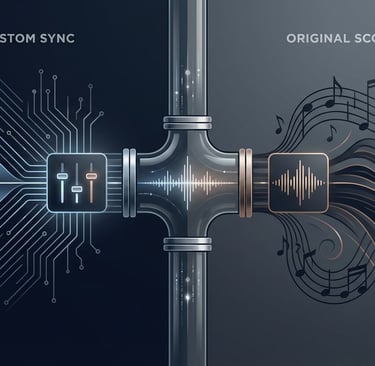
The Illusion of the Unified Catalog
For a long time, the music-for-media industry was content with two silos: on one side, library catalogs for volume; on the other, the composer for narrative prestige. However, the evolving needs of music supervisors in Los Angeles have shattered this binary model. Today, expertise is no longer just about the quality of the music, it’s about the precision of operational positioning. As Variety Intelligence Platform highlights in its recent analyses on content production, audience fragmentation imposes a much more granular management of musical assets, where deployment speed has become as crucial as the artistic signature.
Custom Sync: The Powerhouse of the Modern Pipeline
The real growth engine for premium catalogs is no longer "stock," but "Custom." We aren't talking about scoring in the traditional sense here, but rather a surgical reactivity to the brief. Custom Sync is the hybrid ability to produce original works using synchronization codes (immediate impact, edit-friendly structure, total Work-for-Hire control) within turnaround windows that are often less than 48 hours. For a catalog, Custom is not an artistic option; it is an infrastructure. According to Guild of Music Supervisors (GMS) standards, this agility allows for meeting the demands of ad agencies and trailer houses that can no longer wait for the production cycles of an original score. This is where the value-add battle is won: where a standard license has become a commodity, Custom stands out as a high-end, integrated consulting service.
Maintaining the Line: The Sacred Boundary of Scoring
However, it is crucial to maintain a clear line of demarcation with Original Scoring. While Custom fulfills a punctual sync need, Scoring defines a project's deep DNA. To confuse the two is to ignore the reality of revenue streams and rights structures, a point of vigilance frequently raised at California Copyright Conference panels. Scoring is long-term narrative architecture; the job is not to "place a track," but to build a coherent sonic language. Yet, modern B2B strategy, supported by Synchtank analyses on asset valuation, dictates an intelligent porosity: a score should no longer "die" when the credits roll. It must be envisioned from its inception as a future catalog of assets available for licensing, closing the loop between pure creation and sustainable commercial exploitation.
Toward "Operational Sync Literacy"
The challenge for institutions and rights holders is to acquire this "operational literacy"—the understanding that we are not simply selling music, but rather solutions involving rights and time. A catalog attempting to pitch "score" where the market expects "custom" demonstrates a structural misunderstanding of the production pipeline. As the Music Business Association advocates, the future belongs to entities that know how to segment their assets: catalog depth for recurring revenue, Custom agility for high-value-add opportunities, and Scoring authority for long-term intellectual property. It is within this precise alignment that the true leverage for growth in the international market resides in 2026.
References and Consulted Sources:
Guild of Music Supervisors (GMS): Operational Standards for Custom Music Production (2026)
Variety Intelligence Platform: Content Fragmentation and the New Music Licensing Landscape
California Copyright Conference: Rights Structures in Custom vs. Original Score
Synchtank: Maximizing Asset Value - From Score to Sync Catalog
Music Business Association: Strategic Alignment in Modern Music Publishing