Contract Alert: Do Not Sell Your Sonic DNA to AI
In April 2026, a new threat is emerging for rights holders: the inclusion of hidden clauses authorizing the training of proprietary AI models using stems (isolated tracks). What some labels and brands are framing as "service improvement" is actually a capture of your Sonic DNA. This article analyzes the recent alert from ArtistRack and explains why your stems have become the most coveted, and most vulnerable, assets in the production pipeline.
Klem Loden
4/20/20262 min read
The ArtistRack Alert: The Wolf in the Contractual Fold
The organization ArtistRack has recently released an alarming report on the evolution of "standard" synchronization contracts. Under the guise of vague terms like "Data Processing" or "Technology Improvement," certain brands and libraries are now granting themselves the right to use your audio files to train their own AI models. The objective is clear: to utilize your stems to generate infinite variations of your production style, your "Sonic DNA", in the future, without ever having to pay you royalties for these new algorithmic creations.
Why Your Stems are the Primary Target
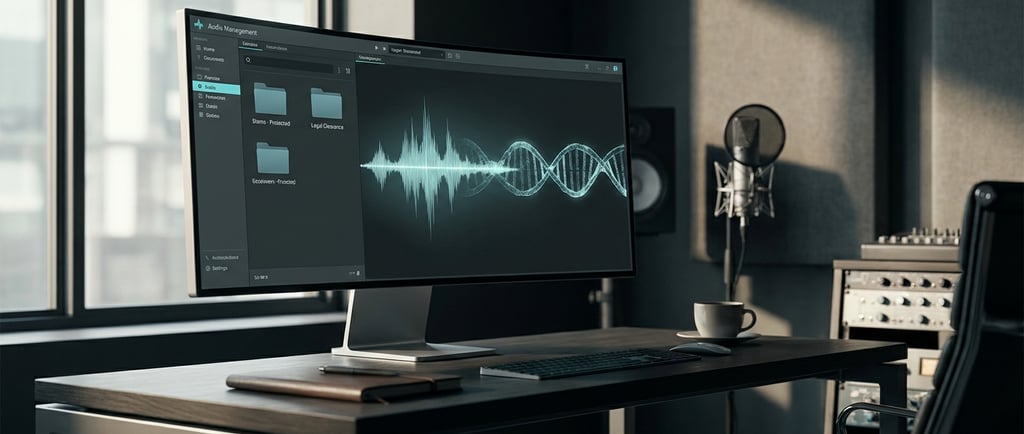
For generative AI, a final mix is a complex data set that is difficult to deconstruct. Stems, however, are pure data: a bass texture, a vocal grain, or an isolated rhythmic structure. By accessing your separate tracks, companies are no longer just licensing a work; they are acquiring the very engine of your creativity. As the Production Music Association (PMA) points out, once a model has "learned" your patterns from your stems, that value is permanently transferred to the algorithm. You are quite literally training your own replacement.
The Red Flags of 2026
Structural alignment of your catalog now demands a "DevOps" level of legal vigilance. Specific terminology such as "Machine Learning and Model Training" serves as an explicit authorization to clone your identity. Similarly, clauses mentioning "Derivative Works via Algorithmic Synthesis" allow for the creation of sound-alikes based on your signature work. You must also be wary of "Perpetual rights for Service Improvement," which is a common catch-all phrase used to mask the ingestion of data into Large Music Models (LMM).
Protection Strategy: The Sonic DNA Firewall
To remain "Sync-Ready" without being "AI-Exploited," it is imperative to integrate strict exclusion clauses. Your contracts must explicitly stipulate that the rights granted specifically exclude the use of the Licensed Property for the training, fine-tuning, or development of any generative artificial intelligence models. Furthermore, using protective metadata, such as the "NO_AI_TRAINING" tag in ISRC and ID3 files, is becoming a recommended industry standard to prove your intent in the event of a future dispute, a practice increasingly supported by the Music Business Association.
Human Reliability as a Premium Asset
In 2026, the industry is splitting in two: those who sell off their influence to algorithms and those who protect their signature. Legal clarity is no longer just about "One-Stop" or split sheets; it is about the survival of your identity as a producer. Protecting your stems ensures that your value remains in your hands and not in the code of a third-party server. In the modern synchronization economy, your music is the product, but your Sonic DNA is your capital. Do not liquidate it inadvertently.
References and Consulted Sources:
ArtistRack: Sync Licensing & AI - Protecting Your Sonic DNA in 2026 (April 8, 2026)
Production Music Association (PMA): AI Training Licenses - Are You Training Your Replacement?
Musicians For Musicians (MFM): Next-Level Criminality - AI Clauses in Distribution and Sync Agreements
U.S. Copyright Office: Updated Guidelines on Synthetic Derivatives and Authorship
Music Business Association: Digital Asset Management and AI Liability Standards (Q1 2026 Report)